Colors of Confinement by Muller Eric L
Author:Muller, Eric L.
Language: eng
Format: epub
Publisher: The University of North Carolina Press
Published: 2012-03-14T16:00:00+00:00
Smart then listed several reasons why Japanese Americans should be allowed access to cameras inside the camps. In addition to dismissing the fear that Japanese Americans would use cameras to photograph “military objectives,” Smart reasoned that Japanese Americans should have the right to create a photographic record of their lives, “particularly to record the lives of their youngsters in an informal fashion.” Smart is arguing here for the right to the family snapshot.
Discussions of photography and rights most often focus on images that contain documentary evidence of crimes, death, or torture. But during the incarceration of Japanese Americans, two-thirds of whom were U.S. citizens by birth, the denial of the camera was part of the eclipsing of a wide range of rights, some constitutional (imprisonment without due process) and others that were part of a more informal array of rights that included the right to representation (cameras as contraband). The argument to restore the right to photography was not embedded in a desire to document the suffering that the imprisonment caused but rather in the desire to document daily events in spite of the imprisonment, and through the vernacular photograph to reclaim a piece of the rights of citizenship. As Ariella Azoulay argues in The Civil Contract of Photography, “Becoming a citizenry of photography entails seeking, by means of photography, to rehabilitate one’s citizenship or that of someone else who has been stripped of it.”6 The very ordinariness of the practice of photographing birthday parties and sporting events signifies how essential those kinds of everyday snapshots are for constructing a normal sense of self.
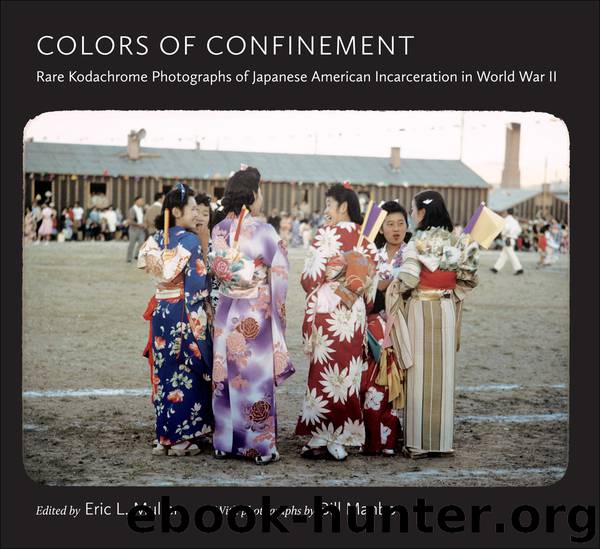
Smart also reasoned that with the abundance of spare time facing prisoners, the camera could give Japanese Americans a constructive way to spend their days. Bill Manbo seems to have been just the kind of person that Smart had in mind. Manbo was an amateur photographer, a hobbyist, and his experience in Heart Mountain became framed through his camera’s lens. Manbo clearly took advantage of the allowance of the camera to focus on the growth of his own son and events inside camp, as well as to train his own eye in photographic composition. In terms of vernacular photography, Manbo’s lens often gravitated toward common subjects—a rainbow, a beautiful sunset, a family portrait, a celebration. Yet in these photographs, it is impossible not to notice the barracks, the barbed wire, the guard towers, and therefore how measured the joy, the play, and the beauty must have been.
The news of the release of some articles from contraband status made its way to Japanese Americans in camp newspapers.7 During the spring, summer, and fall of 1943, newspapers in camps located outside of the Western Defense Command ran front-page articles with headlines such as “Defense Command Releases Contraband,” and “Contraband Ruling Eased.”8 The conditions for the release of cameras and other items included that objects could only be returned to original owners and that those owners had to be either U.S. soldiers, citizens living outside of the Western Defense Command (WDC), or someone exempted from WDC proclamations.
Download
This site does not store any files on its server. We only index and link to content provided by other sites. Please contact the content providers to delete copyright contents if any and email us, we'll remove relevant links or contents immediately.
Shoot Sexy by Ryan Armbrust(17728)
Portrait Mastery in Black & White: Learn the Signature Style of a Legendary Photographer by Tim Kelly(17006)
Adobe Camera Raw For Digital Photographers Only by Rob Sheppard(16976)
Photographically Speaking: A Deeper Look at Creating Stronger Images (Eva Spring's Library) by David duChemin(16687)
Bombshells: Glamour Girls of a Lifetime by Sullivan Steve(14073)
Art Nude Photography Explained: How to Photograph and Understand Great Art Nude Images by Simon Walden(13046)
Perfect Rhythm by Jae(5403)
Pillow Thoughts by Courtney Peppernell(4283)
The Book of Joy by Dalai Lama(3986)
Good by S. Walden(3556)
The Pixar Touch by David A. Price(3438)
A Dictionary of Sociology by Unknown(3085)
Fantastic Beasts: The Crimes of Grindelwald by J. K. Rowling(3058)
Stacked Decks by The Rotenberg Collection(2883)
Humans of New York by Brandon Stanton(2873)
Read This If You Want to Take Great Photographs by Carroll Henry(2711)
On Photography by Susan Sontag(2639)
Insomniac City by Bill Hayes(2558)
Photographic Guide to the Birds of Indonesia by Strange Morten;(2534)
